
Interior Door Materials Compared: Wood, uPVC, and WPC for Saudi Projects
A practical guide to wood, WPC, uPVC, aluminum, and steel doors for Saudi projects, with selection guidance for interiors, wet areas, exterior openings, and fire-rated applications.
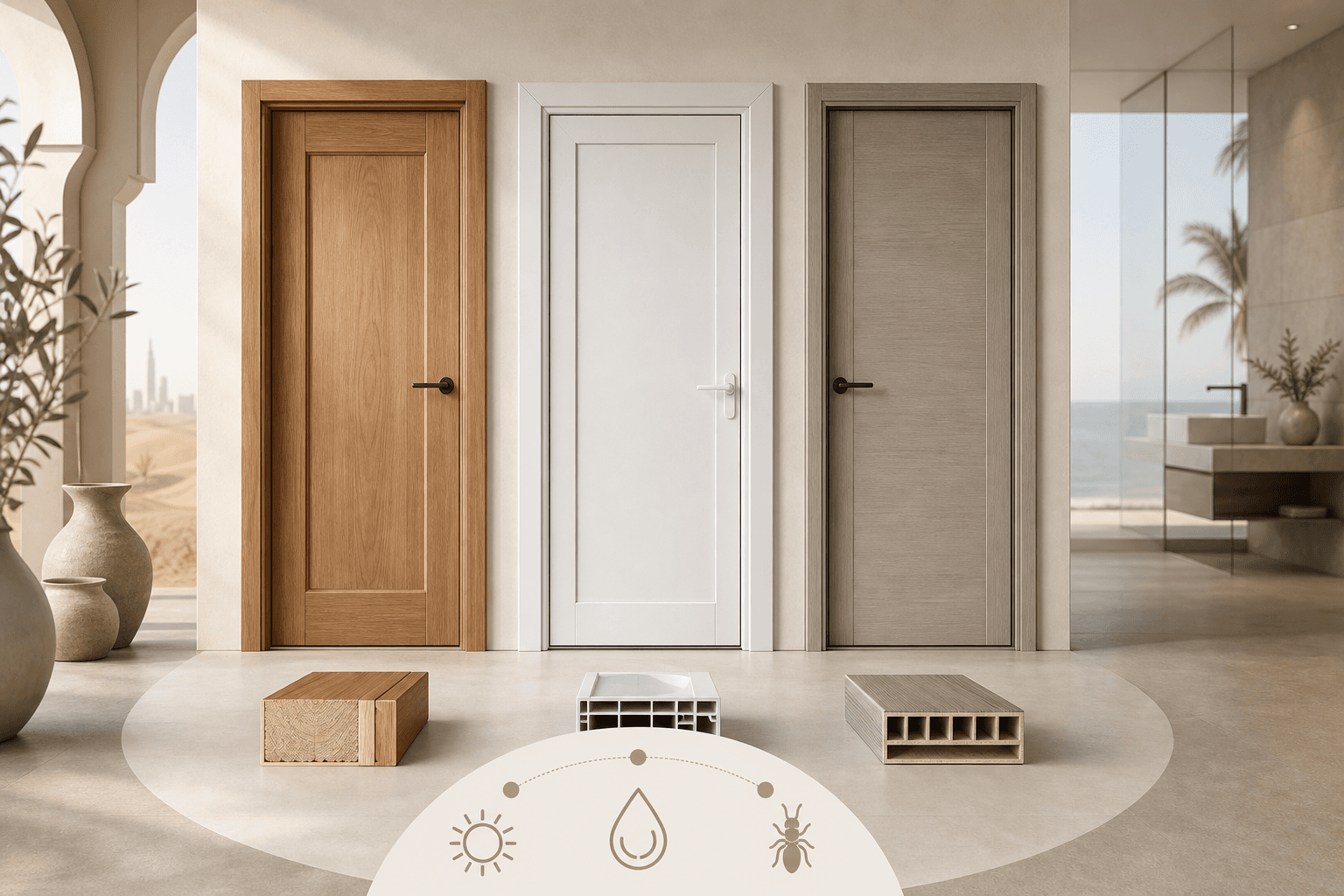
Door material selection looks simple until the project reaches handover and the wrong assembly starts swelling, moving, corroding, or failing to meet the required acoustic, fire, or maintenance performance. In Saudi projects, the right choice depends less on a single “best” material and more on exposure, construction type, hardware, finish, and the tested performance of the complete door assembly.
This guide compares the main door materials used in residential and commercial work and shows where each one makes sense. Product data sheets, approved samples, and project-specific fire, acoustic, thermal, and durability requirements should always take precedence over generic material rules.
Door Construction Types: What’s Inside Matters
Solid-core doors use a dense internal core such as timber, engineered wood, mineral or composite fill. They are heavier and can provide better impact resistance and acoustic attenuation than hollow-core doors, although actual acoustic performance depends on the full assembly, including seals, frame, glazing, and installation.
Hollow-core doors use a lightweight internal structure with thin facings. They reduce weight and cost, but generally provide less impact resistance and acoustic separation and require careful specification where moisture or heavy daily use is expected.
Stile-and-rail doors use vertical stiles and horizontal rails to form a structural frame around panels. The method is common in timber and some composite doors and allows a more traditional panelled appearance.
Flush doors have flat faces and are widely used in modern residential, hospitality, and commercial interiors. Their performance depends on the core, facing, edge construction, frame, and hardware rather than the flush appearance itself.
Material Types Compared
Natural and Engineered Wood
Wood remains a strong choice where appearance, repairability, and a warm architectural finish matter. Its key specification issue is moisture: wood exchanges moisture with the surrounding air, so changes in humidity can cause dimensional movement. Correct drying, acclimatisation, sealing, detailing, and storage reduce the risk of warping, shrinkage, or joint movement.
Engineered wood constructions can offer better dimensional stability than some solid-timber doors because the core and facing are designed to limit movement. Performance still varies by product, so buyers should request the manufacturer’s data, approved sample, edge details, and moisture limitations rather than assume all engineered doors behave the same.
Best suited to: bedrooms, living areas, offices, hotel rooms, and premium interiors where the selected product and finish match the expected moisture and maintenance conditions.
WPC (Wood-Plastic Composite)
WPC combines wood fibre or flour with thermoplastic polymers. Compared with untreated natural wood, many WPC formulations have lower moisture uptake and better dimensional stability, making them useful in wet-area and high-cleaning applications. The exact performance depends heavily on polymer type, wood content, density, additives, and manufacturing quality.
Avoid absolute claims such as “waterproof” or “termite-proof” unless the supplier provides test evidence for the exact product. For project procurement, ask for water-absorption or dimensional-stability data, core density, fixing and screw-holding guidance, surface-finish limitations, and fire-test evidence where a rated assembly is required.
Best suited to: bathrooms, utility rooms, selected kitchen applications, service areas, and interiors where moisture resistance and easy maintenance are more important than a natural-timber construction.
uPVC (Unplasticized Polyvinyl Chloride)
uPVC resists rot and corrosion and is widely used in window and door profiles. It can be practical for wet areas, service doors, and selected exterior openings. For exposed exterior doors in Saudi conditions, the specification should cover UV-stabilised material, profile reinforcement, thermal movement, hardware anchorage, glazing if present, and the manufacturer’s allowable size and exposure limits.
Multi-chamber profiles can improve thermal performance, but the installed door’s U-value and air/water tightness depend on the complete system. A generic uPVC label is therefore not enough for an exterior-envelope specification.
Best suited to: wet areas, utility and service doors, coastal or humid locations where corrosion resistance matters, and exterior applications when the complete system is designed and tested for the exposure.
Aluminum and Steel
Aluminum is lightweight and corrosion resistant and is common in storefronts, glazed entrances, service openings, and exterior systems. Because aluminum conducts heat readily, thermally broken profiles are important where the door forms part of the conditioned building envelope.
Steel provides high strength and is common in security, plant-room, service, and fire-rated applications. In humid or coastal locations, coating systems, edge protection, hardware penetrations, and maintenance are important corrosion-control details.
For fire-rated openings, specify a certified and labelled fire-door assembly with the required rating, frame, hardware, glazing, seals, and installation details. Steel is common in many fire-rated applications, but fire-rated doors are not limited to steel; the accepted material and construction are determined by the tested/listed assembly and project requirements.
| Application | Typical candidates | Key checks |
|---|---|---|
| Bedroom / living interior | Solid or engineered wood, WPC | Core, finish, acoustics, moisture exposure |
| Bathroom / wet area | WPC, uPVC, approved moisture-resistant systems | Water exposure, edges, frame, hardware |
| Exterior / service opening | uPVC, aluminum, steel; engineered systems where approved | UV, thermal movement, corrosion, air/water performance |
| Commercial office interior | Engineered wood, solid-core systems, WPC, selected aluminum | Acoustics, impact, finish, hardware |
| Fire-rated opening | Certified listed assembly; steel is common | Required rating, label, frame, hardware, seals, installation |
| Coastal / humid exposure | WPC, uPVC, aluminum, protected steel | Corrosion protection, moisture limits, hardware grade |
Bedroom / living interior
- Typical candidates
- Solid or engineered wood, WPC
- Key checks
- Core, finish, acoustics, moisture exposure
Bathroom / wet area
- Typical candidates
- WPC, uPVC, approved moisture-resistant systems
- Key checks
- Water exposure, edges, frame, hardware
Exterior / service opening
- Typical candidates
- uPVC, aluminum, steel; engineered systems where approved
- Key checks
- UV, thermal movement, corrosion, air/water performance
Commercial office interior
- Typical candidates
- Engineered wood, solid-core systems, WPC, selected aluminum
- Key checks
- Acoustics, impact, finish, hardware
Fire-rated opening
- Typical candidates
- Certified listed assembly; steel is common
- Key checks
- Required rating, label, frame, hardware, seals, installation
Coastal / humid exposure
- Typical candidates
- WPC, uPVC, aluminum, protected steel
- Key checks
- Corrosion protection, moisture limits, hardware grade
Material is only one part of the door specification; the complete assembly and tested performance govern the final selection.
Procurement Checks Before You Compare Quotes
A useful door quotation should identify the leaf material and construction, dimensions, frame, finish, hardware set, handing, glazing, acoustic or fire rating where required, quantities, approved equivalent rules, lead time, and installation scope. If those items are missing, two apparently similar prices may represent very different assemblies.
For large packages, request samples and technical submittals before final award, especially for WPC and uPVC products where formulation and profile quality vary significantly. For natural timber and veneer, agree on species, grade, colour range, sample approval, moisture condition, and acceptable visual variation.
BennaHub can be used to organise the requirement and compare supplier responses around the same specification, helping the buyer focus on genuine technical and commercial differences rather than reconciling incompatible quote formats.
FAQs
What door material is best for bathrooms?
WPC and uPVC are common candidates because they can offer good moisture resistance. The better choice depends on the exact product, frame and edge construction, cleaning regime, finish, hardware, and whether the door has any fire or acoustic requirement.
Does solid wood warp in the Saudi climate?
Wood can move as its moisture content changes. Correct drying, storage, acclimatisation, detailing, and finishing reduce the risk, while engineered constructions may provide better dimensional stability for demanding conditions.
What is the difference between WPC and uPVC doors?
WPC combines wood-derived material with thermoplastic polymer; uPVC is a rigid unplasticized PVC profile system. WPC is often selected when a wood-like interior appearance is desired, while uPVC is common where moisture and corrosion resistance are priorities. Product-level data should decide the final choice.
Are uPVC doors suitable for exterior use?
They can be, provided the complete door system is designed for the opening size, solar exposure, wind, temperature movement, hardware loads, and required air/water performance. Check the manufacturer’s tested system rather than relying on material name alone.
Do fire-rated doors have to be steel?
No. A fire-rated opening must use a tested/listed and correctly installed assembly with the required rating. Steel doors are common, but other certified constructions can also be fire-rated when their complete assembly is listed for the required performance.
When should I specify a solid-core door?
Use solid-core construction where better impact resistance, a more substantial feel, or improved acoustic performance is required. Confirm the actual acoustic or fire rating from the tested assembly rather than assuming it from the core description.
How should I compare door suppliers?
Issue the same structured specification to every bidder and compare the complete assembly: leaf, core, frame, finish, hardware, ratings, installation, exclusions, warranty, and lead time. Price per door without those details is rarely a like-for-like comparison.
The practical rule is simple: select the door as a system, not just a material. When the exposure, core, frame, hardware, finish, and required test performance are defined first, supplier comparison becomes far more reliable and later substitutions are easier to evaluate.
Prepare this request inside Bennahub.
Upload your BOQ or describe the need, and the platform helps organize line items and specifications and surface gaps before you send.
Start a material request