
Interior vs Exterior Paint in Saudi Arabia: How to Choose the Right System
A practical guide to interior and exterior paint systems for Saudi projects, covering acrylic, alkyd, epoxy, polyurethane, finishes, coastal exposure, and specification checks.
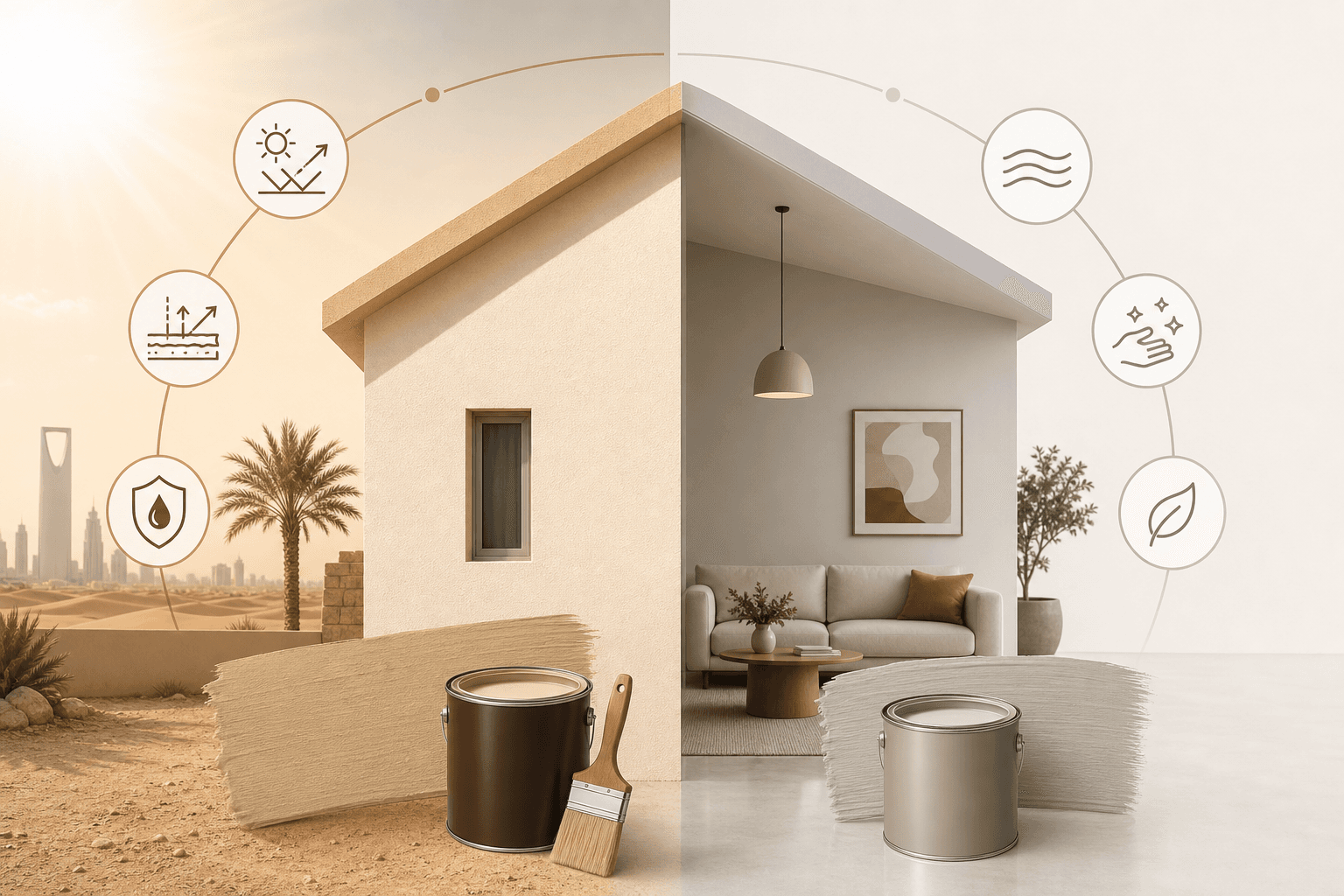
Paint is easy to underestimate because it looks like a simple finishing item. In practice, failures such as peeling, chalking, fading, blistering, corrosion beneath a coating, or poor washability usually trace back to the wrong system, poor surface preparation, or a mismatch between the coating and its exposure.
Saudi projects combine high summer heat, intense solar exposure, dust, and—in coastal areas—humidity and salt exposure. The correct specification therefore starts with the substrate and environment, then moves to resin chemistry, primer, film thickness, finish, and application conditions.
What Separates Interior and Exterior Paint?
Interior coatings are formulated for occupied, comparatively controlled environments. Depending on product class, they may prioritise washability, scrub resistance, stain resistance, low odour or low VOC content, smooth appearance, and easy touch-up.
Exterior coatings are formulated for weathering. Their performance priorities typically include UV and colour stability, adhesion after thermal cycling, water resistance, vapour behaviour appropriate to the substrate, resistance to dirt pickup, and—in humid locations—resistance to biological growth when the formulation is designed for it.
Do not substitute an interior product outdoors simply because the colour or sheen matches. The resin, additive package, recommended dry-film thickness, primer system, and exposure limits can be materially different.
Resin and Binder Types
Acrylic
Water-based acrylic coatings are widely used for architectural walls and facades. Higher-grade 100% acrylic exterior products can provide good UV resistance, flexibility, colour retention, and compatibility with masonry and concrete substrates when the manufacturer’s full system is followed.
Interior acrylics are normally optimised for appearance, washability, touch-up, and occupied-space requirements rather than weather exposure. Product class matters more than the word “acrylic” by itself.
Alkyd
Alkyd coatings form hard, smooth films and remain useful for woodwork, metal, doors, frames, and trim. Some alkyd systems can yellow or lose appearance under strong UV exposure, so exterior use should follow the manufacturer’s stated service conditions rather than a generic rule.
Epoxy
Epoxy coatings are valued for adhesion, chemical resistance, hardness, and high-build protective systems. They are common on industrial floors, plant areas, tanks, and protected steel or concrete. Conventional epoxies can chalk or lose gloss and colour under UV exposure, so exposed systems often use a UV-resistant finish coat such as an appropriate polyurethane, polyaspartic, or polysiloxane system specified by the manufacturer.
Polyurethane
Two-component polyurethane topcoats are widely used where colour and gloss retention, abrasion resistance, or exterior weathering performance are important. They are common over compatible primers and epoxy build coats on exposed steel and high-performance surfaces. Cost and application complexity are higher, so the choice should be justified by the project exposure and performance requirement.
Polyester and Factory-Applied Finishes
Polyester-based coatings are common in factory-applied finishes such as pre-painted metal and coil-coated panels. Their suitability depends on the exact resin system, coating grade, pretreatment, colour, and expected exterior exposure. They should not be treated as equivalent to a site-applied architectural wall paint.
How Saudi Exposure Changes the Specification
Dry inland heat and solar exposure: in cities such as Riyadh, exterior systems need good UV/weathering performance and sufficient flexibility for the substrate and joints. Surface temperature, substrate movement, and application temperature limits should be checked against the product data sheet.
Red Sea and Gulf coastal exposure: humidity and salt-laden air increase corrosion risk on metal and can increase biological growth on shaded or damp masonry. Use compatible corrosion-control primers on metal and exterior masonry systems intended for the local moisture exposure.
Dust and sand: rough, highly textured surfaces can hold more dust and may be harder to clean. Dirt pickup and cleanability should therefore be considered together with the architectural texture and sheen.
Finish Types and Where They Fit
| Finish | Typical use | Practical note |
|---|---|---|
| Flat / matte | Ceilings, low-traffic interior walls, selected exterior systems | Hides surface imperfections; exterior cleanability depends on product |
| Eggshell / low sheen | Living areas, bedrooms, light commercial interiors | Balance of appearance and cleanability |
| Satin | Kitchens, bathrooms, higher-cleaning interiors; some exterior systems | Easier cleaning, but sheen highlights substrate defects |
| Semi-gloss / gloss | Doors, trim, metal, selected high-durability surfaces | Higher sheen is not a substitute for UV-resistant resin chemistry |
| Elastomeric | Exterior masonry where movement or hairline crack bridging is part of the system design | Check crack-bridging limits, vapour behaviour, and compatible primer |
Flat / matte
- Typical use
- Ceilings, low-traffic interior walls, selected exterior systems
- Practical note
- Hides surface imperfections; exterior cleanability depends on product
Eggshell / low sheen
- Typical use
- Living areas, bedrooms, light commercial interiors
- Practical note
- Balance of appearance and cleanability
Satin
- Typical use
- Kitchens, bathrooms, higher-cleaning interiors; some exterior systems
- Practical note
- Easier cleaning, but sheen highlights substrate defects
Semi-gloss / gloss
- Typical use
- Doors, trim, metal, selected high-durability surfaces
- Practical note
- Higher sheen is not a substitute for UV-resistant resin chemistry
Elastomeric
- Typical use
- Exterior masonry where movement or hairline crack bridging is part of the system design
- Practical note
- Check crack-bridging limits, vapour behaviour, and compatible primer
Choose sheen together with resin system, substrate condition, cleanability, and manufacturer guidance; sheen alone does not determine exterior durability.
Selection Guidance by Project Type
Residential villas and apartments: interior acrylic systems for general walls; exterior acrylic or elastomeric systems where compatible with the facade substrate; dedicated wood/metal coatings for doors, frames, and trim; floor coatings only where the service condition justifies them.
Commercial fit-outs: washable interior systems for walls, higher-durability coatings in back-of-house or service areas, and project-specific coatings for metal, millwork, wet rooms, and high-contact surfaces.
Industrial and warehouse facilities: select protective coating systems from the actual chemical, abrasion, UV, corrosion, cleaning, and substrate exposure. Epoxy, polyurethane, polyaspartic, polysiloxane, or other technologies may be appropriate depending on the duty.
What to Request from Paint Suppliers
A serious paint comparison should start with the manufacturer’s product data sheet and, where relevant, safety data sheet. Compare resin chemistry, recommended substrate and primer, solids by volume, theoretical coverage, wet and dry film thickness, number of coats, application method, recoat window, temperature and humidity limits, cure time, finish, colour limitations, and any project-relevant test data.
For protective or exterior systems, also confirm weathering/UV data where provided, corrosion-protection requirements, compatibility between coats, repair procedure, and warranty conditions. Price per litre is not a useful comparison if solids content, coverage, or required film build differs.
BennaHub can help structure the coating requirement and keep supplier responses around the same specification, making it easier to compare the complete system rather than isolated product names or litre prices.
FAQs
Can I use exterior paint indoors for extra durability?
Do not make that substitution automatically. Exterior formulations can use different additives and may not be intended for occupied interiors. Use a product rated for the indoor environment and the required washability or durability, and follow the manufacturer’s stated use.
What is a practical paint system for a concrete facade in Riyadh?
A quality exterior acrylic system is a common starting point, but the correct system depends on substrate condition, cracks, moisture, previous coatings, desired texture, and exposure. Elastomeric systems may be considered where their crack-bridging and vapour properties fit the substrate. Use the manufacturer’s complete primer-and-topcoat specification.
Is epoxy suitable as an exterior topcoat?
Many conventional epoxies are not chosen as exposed decorative topcoats because UV can cause chalking, yellowing, or gloss loss. Where an epoxy provides the build or chemical resistance, the exposed system often uses a compatible UV-resistant finish coat. Always follow the specific product system because specialised UV-resistant epoxies also exist.
What should I specify for coastal exterior masonry?
Use an exterior masonry system intended for high humidity and the actual substrate, with compatible primer and surface preparation. On adjacent metal, corrosion control becomes a separate critical requirement. Do not rely on sheen alone to solve coastal durability.
How do I compare two paint quotes fairly?
Compare the system, not the can: primer, number of coats, solids by volume, coverage, required dry-film thickness, surface preparation, colour, application method, accessories, warranty, and total installed scope. A lower litre price can produce a higher system cost if it needs more material or additional coats.
The most reliable paint specification starts with exposure and substrate, then selects a tested coating system that the contractor can apply under the site conditions. Resin name and sheen are useful clues, but the product data sheet and complete system are what should govern the purchase.
Prepare this request inside Bennahub.
Upload your BOQ or describe the need, and the platform helps organize line items and specifications and surface gaps before you send.
Start a material request